Web · 2026 · Project 12
Ledger Lab
An interactive bookkeeping lab with four learning paths — daily operations, reconciliations, payroll, close, and reporting — plus a tutor that explains the reasoning behind a line item.
- Status
- Live
- Role
- Curriculum structure, interface, tutor integration
- Timeline
- Multi-week build
- Stack
- HTML, CSS, JavaScript, Instructional design
The problem
Bookkeeping courses tend to be either a video you watch passively or a worksheet with no feedback. Neither builds the reflex that matters: looking at two records that do not agree and working out why.
I wanted a lab where the learner actually prepares the reconciliation, enters the numbers, and gets told what is wrong — with the reasoning, not just the answer.
What I built
Four learning paths, each with a sequence of labs:
- Daily operations — vendor bills, early-payment discounts, customer payments, AR aging and collections.
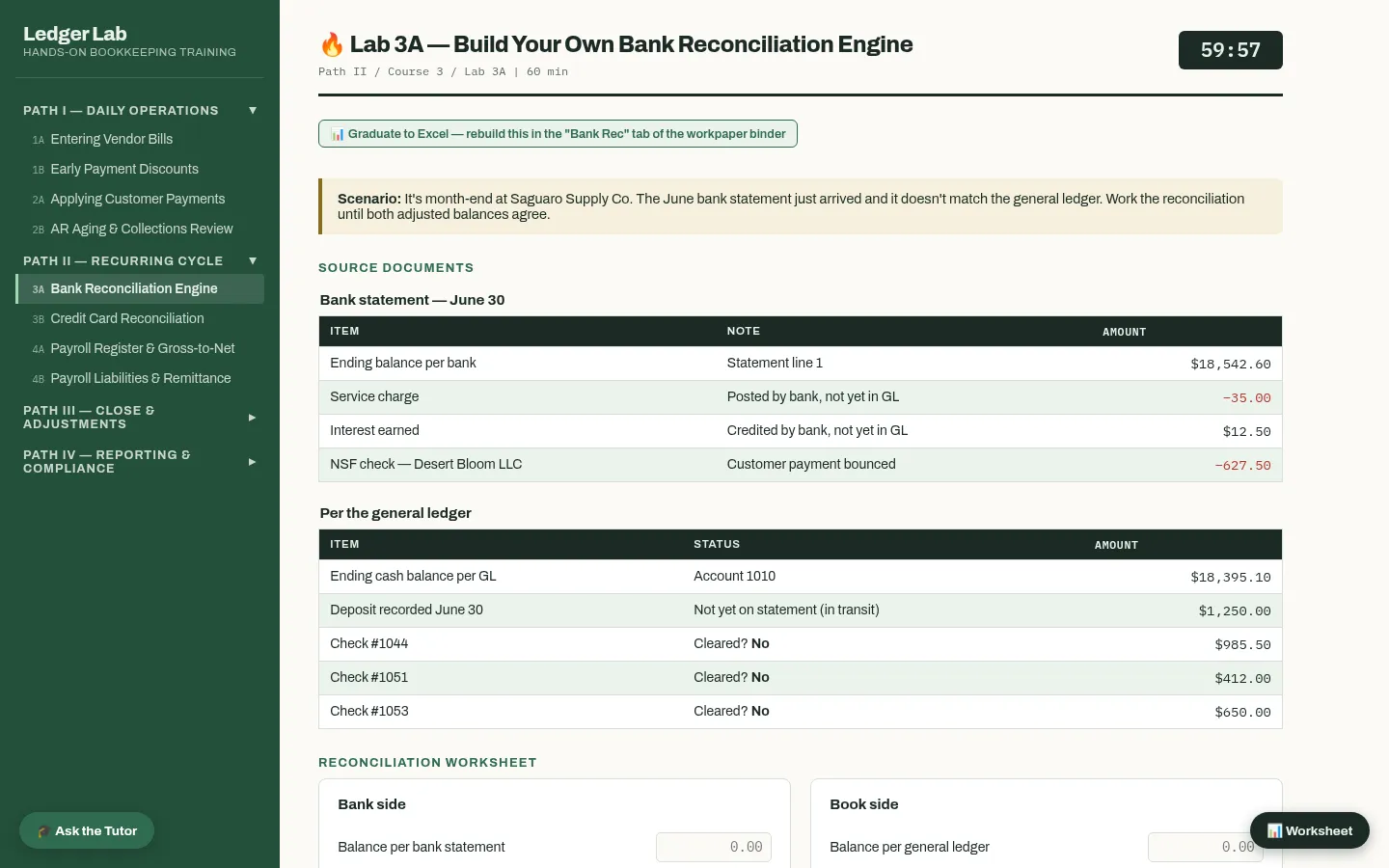
- Recurring cycle — bank reconciliation, credit-card reconciliation, payroll register and gross-to-net, payroll liabilities and remittance.
- Close and adjustments — prepaid expenses, accruals, depreciation, and a month-end close capstone.
- Reporting and compliance — manual income statement, balance sheet, sales tax reconciliation, and fixed assets.
Each lab presents source documents, a general ledger, and a worksheet the learner fills in. The worksheet checks the balances and explains the discrepancy instead of just marking it wrong.
There is also a tutor that works on highlighted text: select a term or a line item, ask a question, and it explains the reasoning behind that specific thing.
The design decisions
The labs are built around a consistent document → worksheet → check loop. Once the learner understands one lab, the next one is legible. That consistency is what makes a long curriculum feel navigable.
The worksheet is a stateful form with calculated fields and validation. Doing that without a framework was a deliberate choice: the whole lab loads fast, works on a cheap laptop, and has no build step to rot.
What I learned
The teaching happens at the error. A wrong number with a good explanation teaches more than a right number with a checkmark, so most of the interface effort went into the feedback.
I also learned how much instructional design is really information architecture. The path names, the order of labs, and the visible progress matter as much as the accounting content.
Honest limits
This is a training environment built around a fictional company and illustrative numbers. It is not a bookkeeping system, and it is not accounting advice.
A training tool, not accounting or tax advice.
What this proves for your business
- I can turn a dry professional skill into a guided, hands-on exercise.
- I can build complex stateful forms — reconciliation worksheets — without a framework.
- I design for the moment someone gets stuck, not just the happy path.