Security · 2026 · Project 02
PySEC Academy
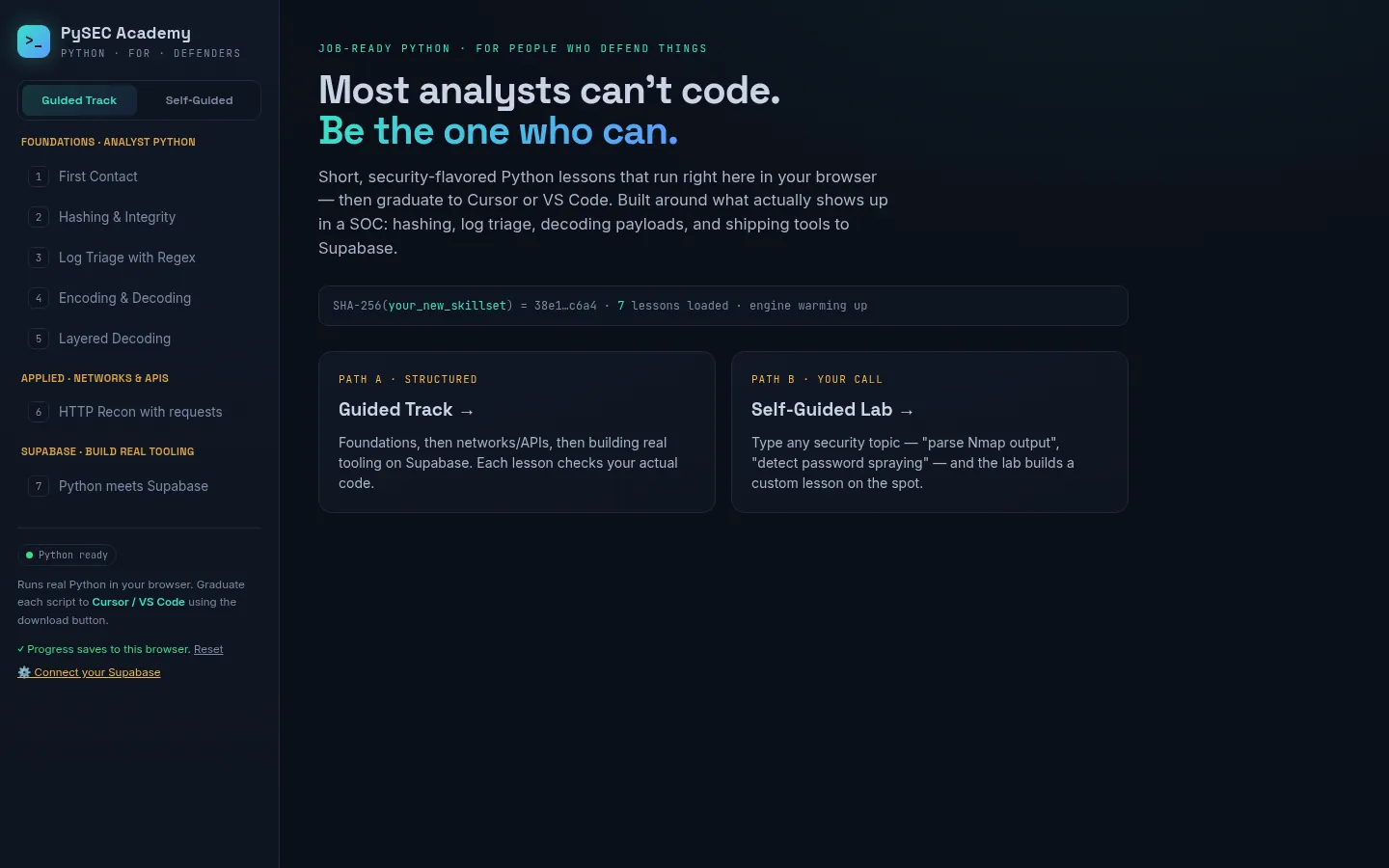
A browser-based Python learning platform for people who defend things. Real Python runs client-side through Pyodide, with Supabase auth and row-level security so each learner's progress stays private.
- Status
- Live
- Role
- Curriculum, platform, frontend, auth model
- Timeline
- Several weeks, still expanding
- Stack
- Python, Pyodide / WebAssembly, Supabase, JavaScript, Row-level security
The problem
Most security analysts can read a log and explain what happened. Fewer can write the ten lines of Python that would have caught it automatically. The gap is not intelligence; it is that most Python courses are built for future software engineers, not for people working in a SOC.
I built the course I wanted while studying for Security+ — short, security-flavored lessons that end with a working script.
What I built
PySEC Academy is a static frontend with a real Python runtime inside it. Pyodide compiles Python to WebAssembly, so learners execute code in their own browser. There is no server-side execution path to secure, which is a meaningful design decision for a platform that runs arbitrary learner code.
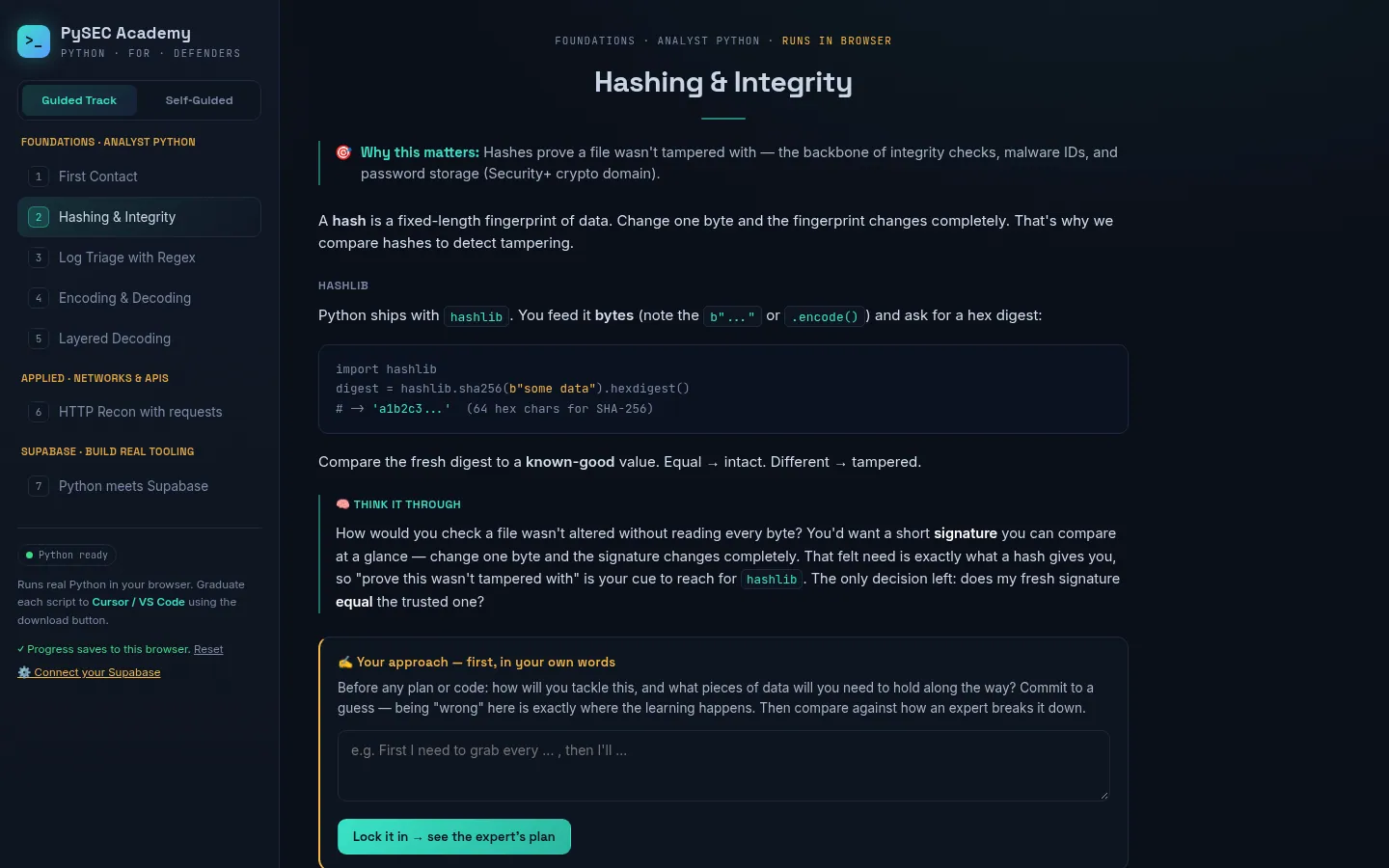
- A guided track covering hashing, log triage with regex, encoding and decoding, layered decoding, HTTP recon, and building tooling against Supabase.
- A self-guided mode where a learner names a topic and gets a lesson built around it.
- Downloadable scripts so a lesson can graduate into Cursor or VS Code instead of dying in a browser tab.
- Supabase auth with row-level security policies so progress is scoped to the authenticated user at the database layer.
- An AI tutor behind a Supabase edge function, rather than an API key sitting in client-side JavaScript.
The design decision that mattered
The original temptation was a Python execution backend. It would have been easier and it would have been a liability: a public endpoint that runs arbitrary code is a standing invitation.
Pyodide removes that entire class of risk. The tradeoff is bundle size and startup time, so the app degrades into an IDE-style mode when the engine cannot load, and says so plainly instead of pretending the lesson is broken.
What I learned
Curriculum design is harder than the code. A lesson that explains hashing is easy to write and easy to forget. A lesson that asks the learner to predict what changes when one byte changes, then runs the code to settle the argument, is the one that sticks.
I also learned to respect the failure states. Offline engine, expired session, no Supabase connection — each one needed an honest message and a path forward, not a spinner.
Note on the public demo
The live site is the real application. Supabase-backed features (accounts, saved progress, AI tutor) require a Supabase project, and the app lets a visitor connect their own. The lessons and the in-browser Python engine work without one.
What this proves for your business
- I can design a learning experience, not just a page that displays text.
- I know how to run untrusted code in a browser without putting a server at risk.
- I can implement per-user data isolation properly, with database-level policy rather than frontend hiding.